
Survey first: $300–$750
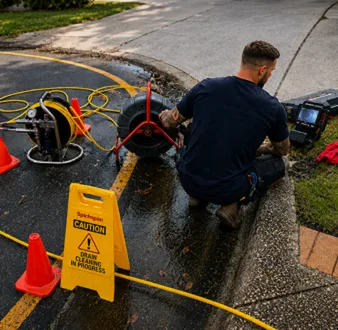
A recorded camera run with distances marked. Yours to keep, and usually credited if the work goes ahead.
We camera the line first, show you what is actually wrong, and then tell you whether relining is the right answer. Often it is. Where the pipe has collapsed or lost its fall, it is not, and we will say so rather than sell you a liner that disappoints.
A resin-saturated liner is drawn into the existing pipe through an access point, inflated so it presses against the wall, and cured until it hardens. What you are left with is a continuous pipe inside the old one, with no joints along its length and a slightly smaller bore than the original.
Nothing is excavated, and the cured surface is smoother than the clay or concrete it lines, so flow is typically maintained or improved despite the small loss of diameter. On a property where a driveway, mature garden or paving sits over the line, that is the whole argument.

On stable ground a short patch over a single defect is often the proportionate repair. On reactive soil it frequently is not, because the movement that opened one joint has been working on every other joint in the same run for the same number of years.
That is worth knowing when you compare quotes. The cheaper patch can be the right call, but on this ground the full-length liner is more often the one that ends the problem rather than relocating it a metre.
An open joint leaks in both directions. On a low-lying block that means stormwater and groundwater entering the sewer through cracks, which is called infiltration, and it quietly overloads a line that would otherwise cope.
During heavy Macarthur downpours, leaf-choked stormwater pits and pipes overflow and back up around the yard and downpipes.
It shows up as a system that backs up in wet weather and behaves perfectly in dry. If that is the pattern, sealing the run is the fix, and no amount of clearing will reproduce the result.
The clay ground through Camden South swells and shrinks between wet and dry spells, shifting and cracking buried pipes over time.
Clay is rigid, round and predictable, and that geometry is exactly what a liner wants. The resin sleeve cures hard against a barrel that holds its shape, and the short pipe lengths that make clay joint-heavy are the same joints the liner seals in one pass.
So the material that causes the most recurring blockages in older streets is also the easiest to repair properly without digging. That is a genuinely lucky combination and it is why relining suits this housing stock so well.
Removing a mature tree is expensive, often needs approval, and frequently does not solve it: the roots already inside the pipe do not leave when the trunk does, and the joint is still open for the next one.
Camden South’s established gardens and street trees send roots hunting into older pipe joints, a top cause of the recurring blockages we clear here.
Relining lets both things be true at once. The garden stays as it is and the drain stops being a route to water. For most owners that is the whole appeal, and it is why no-dig gets specified on established blocks far more often than on new ones.
Camden South sits just below the historic town centre in Sydney’s Macarthur region (postcode 2570), a settled residential suburb of established homes alongside newer streets. Bordering Camden, Elderslie and Spring Farm, its mix of maturing pipework and reactive clay soil keeps our local drain crews busy, and we know the ground here well.
Reactive clay soil moves with the seasons, lifting in the wet and shrinking back in a dry spell. Rigid drainage laid through it gets flexed every year, and the joints are where that movement is absorbed until they stop absorbing it.
It is the reason drainage faults on these soils cluster after a long dry followed by heavy rain. The pipe did not fail that week; it finished failing that week.
Cutting roots out clears the pipe and does nothing about the way in. The joint they came through is still open, the tree is still looking for water, and the interval before the next blockage is set by how fast it grows back. That is why a jetted line often reblocks on a schedule you could almost diary.
A liner seals the full run, joints included, so there is no opening left to find. It is the one intervention that changes the pattern instead of resetting the clock.
A recorded camera run with distances marked. Yours to keep, and usually credited if the work goes ahead.
The prevailing 2026 Sydney range for residential sewer relining.
Proportionate for one fault in a sound run. We will recommend it over a full liner when that is what the camera shows.
For a run failing along its length, which on old clay is the common finding.
Plus reinstatement. On a bare lawn it can win. Under anything you would miss, it usually does not.
Figures reflect the 2026 Sydney market rather than a quote. You get your own number once we have seen inside the pipe. Figures here are indicative of the 2026 Sydney market rather than a quote from us, you get your own number as a fixed price before any work starts.

A CCTV survey establishes the material, the diameter, where the defects are and how far they sit from the access. You see the footage, and it is what the quote is built from.
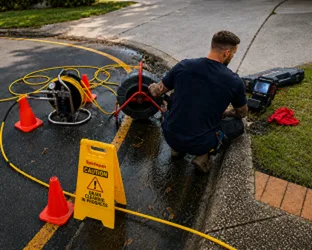
Patch or full length, and occasionally excavation instead. We will tell you when digging is the better answer even though it is the bigger quote.
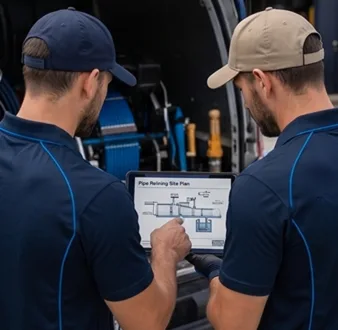
The run is jetted so the liner bonds to pipe rather than debris, the liner is installed through the existing access, and it cures in place. Most domestic jobs are a single day.

Every branch the liner passed is reopened from inside, then the run is cameraed again so you can see it is continuous and the junctions are clear.
Leave your details and a licensed plumber will call back to arrange the survey. No quote is given before someone has seen inside the pipe.
Call for the fastest answer, or send the form and we will arrange a camera survey before anything is quoted.

Leave your details and our local Camden South team will call you back fast.